Dancing at Ciro's by Sheila Weller
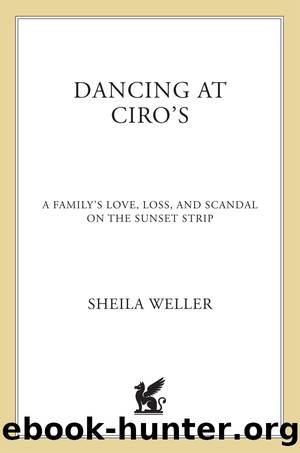
Author:Sheila Weller
Language: eng
Format: epub
ISBN: 9781250097828
Publisher: St. Martin's Publishing Group
Part III
Chapter Eight
HOLLYWOOD AND BEVERLY HILLS: 1946â1951
Can anyone remember a moment from infancy? Or do we reconstruct such memories in early childhoodâfrom the evidence we felt and knewâuntil they are as real as life?
I remember being lifted high in the solarium-turned-nursery of Uncle Hermanâs Bedford Drive home, in a torrent of light glinting off the dark-watered swimming pool. My whole childhood was bathed in that crystaline, dry, unblinking L.A. basin sunlight, and it seems the outpouring started there: light jumping through the window, bouncing off the white nursery furniture and Mollyâs starched white uniform, and beaming off her soupy bifocal globes. Molly was my guardianâmy everythingâfor the three months that my mother tended infectious Lenny elsewhere in the house.
Those first three months in L.A. had been a nightmare for my mother. Right after she had run in and kissed Lenny, his doctor had forbade her to touch her baby, so infectious was Lennyâs disease deemed to be. So she could do no more than wave at me through a window Herman had constructed between one wing of the house and the nursery, while she spent most of her time watching her younger brother writhe in the throes of an unspeakably painful illness that left him weaker in body and mind every day.
The family did everything they could to try to save him: My father connected Lennyâs doctors with the Lahey chieftains and sent them sheaves of Globusâs meninges research, talking them through the mysteries of spinal-cord membrane arcana on the phone. Herman dispatched couriers to San Francisco and Tijuana for wonder drugs. My mother got the names of touted doctors from Harry Cohn and her now-friend Lana Turner, but nothing worked. One day in April 1946, Lenny slipped into a coma and diedâat thirty-two.
After he was buried and my mother was out of quarantine, she started singing me lullabiesââLavender Blueâ and âOver the Rainbowââher voice breaking all over the place. Her vulnerability was as tactile as my teething ring, setting up a bond that eventually made me as much her caretaker as she was mine.
My father came out to L.A. in June 1946, as soon as his Kings County residency was up, and while he was setting up his practice we lived as a family in Hermanâs house. He couldnât afford to buy us a house right away, and, besides, Helen felt comfortable at Hermanâsâpampered and assisted by the servants, as a new mother and a grieving sister, having her family around her again, just like on Arlington Avenue. Herman was a prince of L.A., and every day he surveyed his domestic domain, with its grand piano at the street end and its black-and-white harlequin tiles toward the back, in a maroon bathrobe with a monogram on its breast. Telephones were always being handed to him as he sat at a massive oak table facing the olive-treed brick patio, beyond which was the swimming pool, its water bottle green. When Uncle was busy, everyone had to be quiet. (âSshh!â Molly would say.
Download
This site does not store any files on its server. We only index and link to content provided by other sites. Please contact the content providers to delete copyright contents if any and email us, we'll remove relevant links or contents immediately.
Cecilia; Or, Memoirs of an Heiress — Volume 2 by Fanny Burney(31959)
Cecilia; Or, Memoirs of an Heiress — Volume 3 by Fanny Burney(31945)
Fanny Burney by Claire Harman(26607)
We're Going to Need More Wine by Gabrielle Union(19052)
Plagued by Fire by Paul Hendrickson(17417)
All the Missing Girls by Megan Miranda(16049)
Cat's cradle by Kurt Vonnegut(15365)
For the Love of Europe by Rick Steves(14166)
Bombshells: Glamour Girls of a Lifetime by Sullivan Steve(14081)
Leonardo da Vinci by Walter Isaacson(13341)
4 3 2 1: A Novel by Paul Auster(12403)
The remains of the day by Kazuo Ishiguro(9004)
Adultolescence by Gabbie Hanna(8930)
Note to Self by Connor Franta(7673)
Diary of a Player by Brad Paisley(7585)
Giovanni's Room by James Baldwin(7352)
What Does This Button Do? by Bruce Dickinson(6210)
Ego Is the Enemy by Ryan Holiday(5455)
Born a Crime by Trevor Noah(5385)
